Talk through your process.Flux finds where it sticks,and what it costs you.
By voice, in writing or from a document. Flux draws the map, asks the questions that are missing, proposes an improved version with every change explained, then puts a number on the hours and dollars recovered each year.
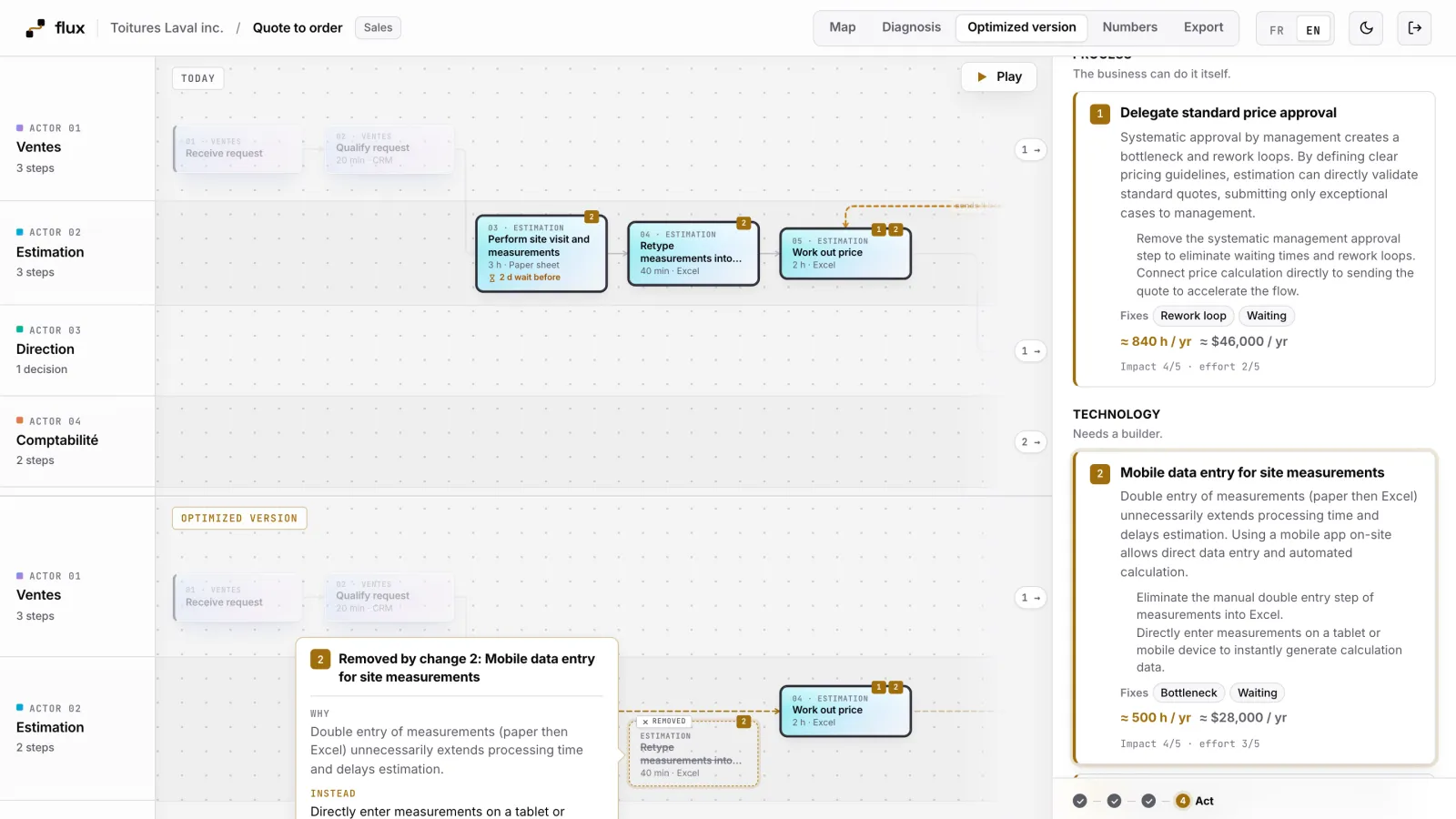
The Flux screen: Toitures Laval's optimized version, with a removed step and its explanation.Flux in under a minute, on the example of Toitures Laval, a fictional company. No sound.The video's text
Talk through your process, the way you would with a colleague.
The map draws itself as you answer.
Flux asks for what's missing.
7 problems. Most important: rework loop.
An improved version, change by change.
A removed step says why, and what replaces it.
≈ 1,200 h and ≈ $64,000 recovered a year.
More like 15 quotes a week? Everything recalculates.
≈ 1,700 h and ≈ $96,000 a year. AI suggests, code does the math.
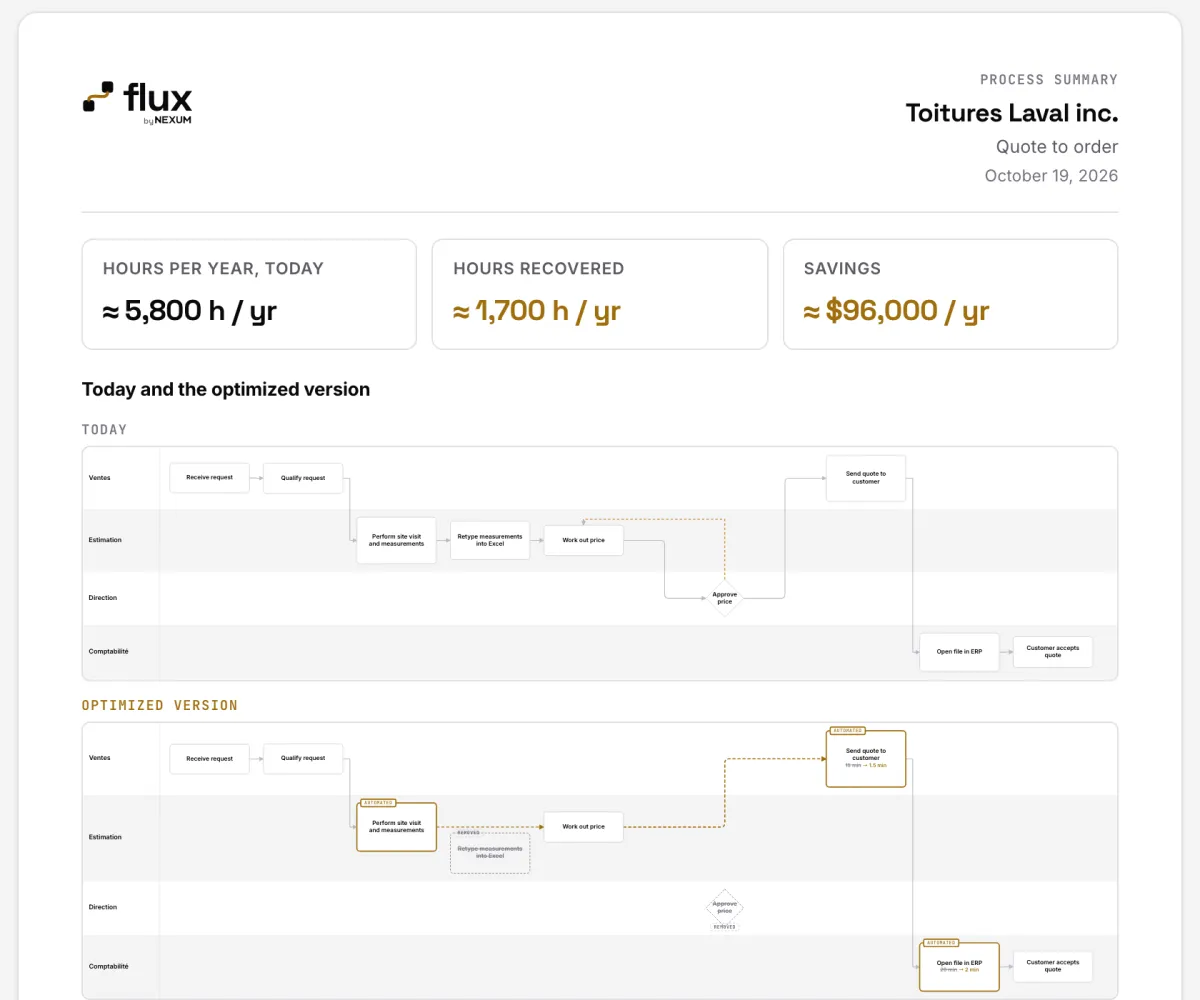
A one-page summary for your next meeting.
Talk through your process. Flux finds where it sticks, and what it costs you.
One example, start to finish
A roofing quote, talked through and costed
The app in
DemoToitures Laval is a fictional company set up for the demo. The text and numbers below are the ones Flux displays for it in English. Its teams keep the French names the company gave them.
01Tell
You talk the way you would to a colleague.
No forms. Hold the button and talk, or type. A meeting transcript or a document (PDF, Word, text) works too.
Flux places the teams, steps, tools and waits on a map that builds as you answer.
Hold to talkAnswer 1
Customers call us or fill in the form on our website. Julie, in sales, qualifies the request in about twenty minutes. Then an estimator goes on site for the visit and the measurements: three hours on site, but we wait about two days before he can come. He works out the price in Excel, which takes him two hours. If the price is over $25,000, Sylvie in management has to approve it, and sometimes she sends it back to be redone. We do about 10 quotes a week.
Toitures Laval inc. · Quote to order
The first answer, spoken out loud. Reproduction of the Flux screen.
02Clarify
It asks the questions that are missing.
Nobody knows a whole process at once. Flux spots what's missing, a duration, a tool, an exception, and asks for it, one question at a time. A few answers are enough for a first analysis. You can go further, or stop whenever you want.
Every number on the map points back to the sentence it came from. If it's wrong, you see who said it, and you fix it.
7 points to clarify12Clarify34
The estimator takes measurements on paper and photos with a phone. What do you use for « Send quote to customer »: software, a spreadsheet, paper or email? When the work reaches « Send quote to customer », how long does it wait before someone picks it up?
Hold to talkor type your answer…
Task · Estimation
Work out price
Duration2 h
ToolsExcel
What was said
« He works out the price in Excel, which takes him two hours »Conversation · Answer 1
The next question, and one step's panel with its source. Reproduction of the Flux screen.
03Analyze
It fixes before it automates.
Flux finds where things stick: waiting, rework, double entry, an approval sitting on a desk. Then it proposes an improved version, change by change. The fixes you can make yourselves come first: automating a broken process just makes more mistakes, faster.
3 changes2 steps removed3 automated
Swipe to see the whole map.
Reproduction of the Flux map for Toitures Laval, today and in the optimized version.
2Removed by change 2: Mobile data entry for site measurements
Why
Double entry of measurements (paper then Excel) unnecessarily extends processing time and delays estimation.
Instead
Directly enter measurements on a tablet or mobile device to instantly generate calculation data.
A removed step says why, and what replaces it. Nothing disappears silently.
Here, one change is within the team's reach: delegating standard price approval. The other two need technology, and come after.
04Act
It puts a number on every change, and shows its work.
For each change, the hours and dollars recovered per year. Every number comes from a value you gave, or from an assumption on display. Change one: everything recomputes.
Try it with the frequency. Both results are the ones Flux displayed for Toitures Laval.
Frequency
Hours recovered≈ 1,200 h / yr
Savings≈ $64,000 / yr
End-to-end lead time2 to 3 days fasterper run
1Delegate standard price approvalProcess≈ 560 h / yr · ≈ $31,000 / yr
2Mobile data entry for site measurementsTechnology≈ 330 h / yr · ≈ $18,000 / yr
3CRM and ERP integration for quote sending and file openingTechnology≈ 260 h / yr · ≈ $14,000 / yr
Assumptions: average hourly cost $55/h, frequency 10 per week, the durations and waits given for each step, and default values on display (250 working days a year, 10% of the work left after automation).
The Flux “Numbers” tab for Toitures Laval. Reproduction of the screen.
One page to bring to your next meeting.
The summary puts today's map and the optimized version side by side, with the hours, the dollars and the changes that matter most. Print it, or send the process to Nexum with “Request an audit”.
Screenshot of the real summary, for Toitures Laval at 15 quotes a week.
What Flux doesn't do
Numbers you can defend
It doesn't guess.
If a duration or a frequency is missing to cost a change, it says so and asks you, instead of making it up.
It doesn't let the AI do the math.
The AI reads and proposes. Code calculates every hour and every dollar, from values you can see and correct.
It doesn't automate a broken process.
Fixes come first. An automation idea blocked by a serious problem stays locked until that problem is fixed.
It doesn't turn waiting into dollars.
Days of waiting are lead time, not paid hours. Flux shows them separately.
Pricing
One price per company
Nexum Flux
CAD 299per month
Per company. Plus applicable taxes.
Unlimited processes, by voice, in writing, from a meeting transcript or a document
A map of each process, with the source of every number
The diagnosis and the improved version, change by change
The hours and dollars recovered per year, with their assumptions
A one-page summary, and an export for Consultant OS
Where Flux keeps what you tell it, and the three services that can process part of it outside Québec.
The app and its databaseOn Google Cloud, in Montréal. To get there, your connections go through Google's global load balancer, which decrypts them at the edge of its network before passing them on to Montréal.
The AIGemini, by Google. Once the Flux update scheduled for Thursday, October 22, 2026 is live, every call goes to Montréal first; if Montréal refuses a call or doesn't answer in time, that call, and only that one, goes to Google's global endpoint, which may process it outside Québec and Canada. Until then, calls go through that global endpoint. That can include anything the AI reads: your answers, your documents, your recordings to transcribe.
Reading questions aloudOff by default. If you turn it on, the text of the questions read aloud goes through Fish Audio, a service outside Québec. That text can include parts of your answers, but not your recordings.
“Request an audit”The email to Nexum, with the full process attached, goes through Resend, in the United States, only when you click.
Your voice and your filesFlux keeps the transcribed or extracted text, not your recordings or your files.
No adsNo advertising or audience-measurement tools in Flux.
Does your company's AI have to stay in Québec, with no exceptions? Write to us before you put your data in: w.rousseau@nexumintelligence.ai
Access
Request your access
We open every account ourselves. You get an email with your access and the subscription link.